Control System
An electric vehicle system can have the right components, the right architecture, and the right hardware and still behave unpredictably if the control software isn't developed with the same discipline as the rest of the system.
Renco treats control software as a system engineering activity, not a software delivery task. The interfaces, the operating states, the fault reactions, and the validation approach are all defined before a line of code is written.
Where the methodology comes from
The team behind renco spent years developing control software in motorsport — including Formula E and F1 programs where software was released on a two-week cycle and system reliability was non-negotiable.
That environment shaped everything about how we work today. The HIL-first approach, the simulation before vehicle, the discipline around validation — none of this came from a process manual. It came from working in conditions where getting it wrong had immediate, visible consequences.
When we apply that methodology to a commercial vehicle program, the result is control software that enters your vehicle with known, validated behavior — not hopeful behavior.
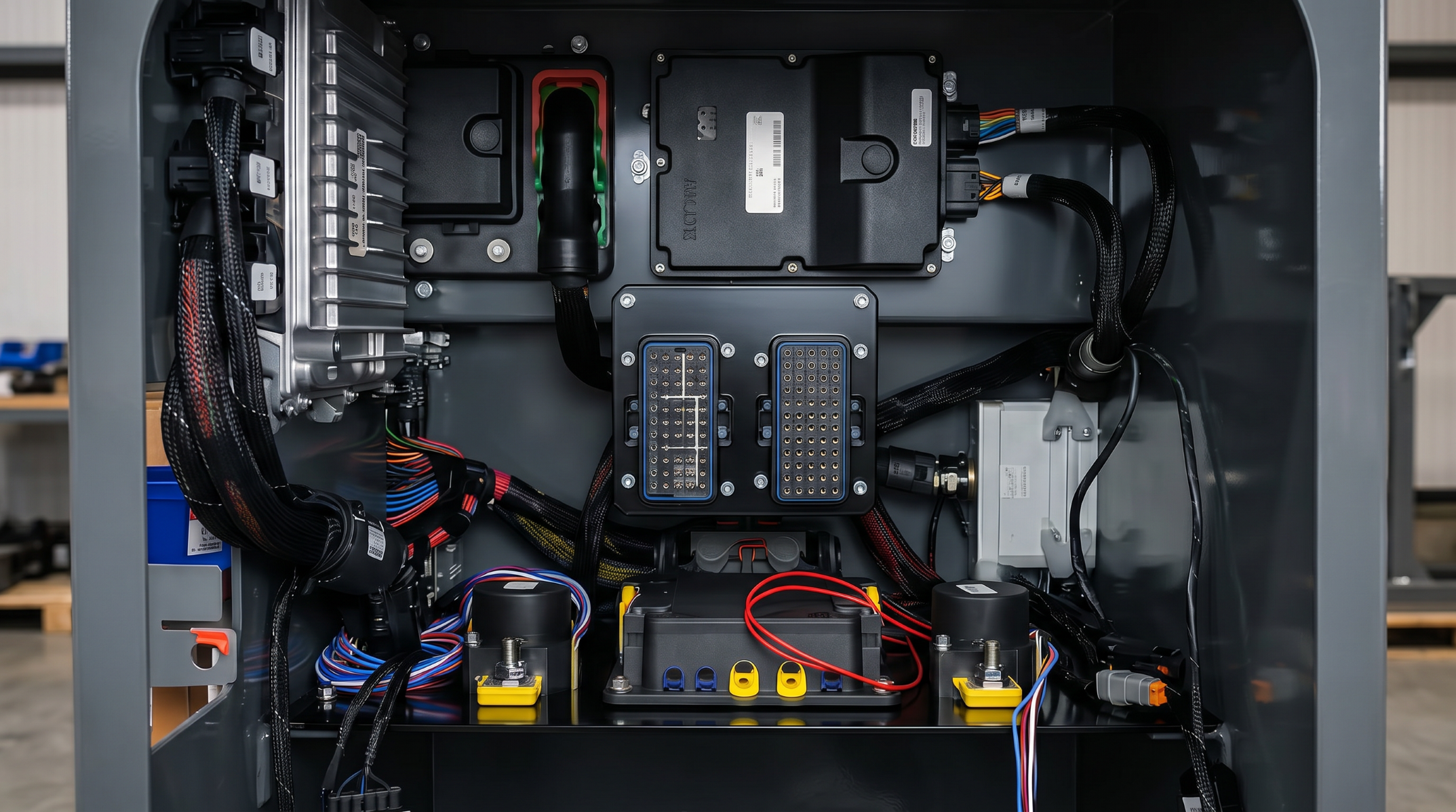
The low-voltage architecture is the nervous system of your vehicle. Every sensor, actuator, and control unit depends on it. If a wire is in the wrong place, the vehicle doesn't move, doesn't charge, or doesn't protect itself correctly.
Renco has been defining and building LV architectures for EV systems since 2010. We know where each wire needs to go — and why.
Our involvement is shaped by what your program needs. At minimum we define the controller interfaces: CAN communications, and the connections between the VCU and every sensor, actuator, and system component. Where the program requires it, we take full responsibility for the schematics, harness design, and harness delivery.
Renco develops the control software that operates the full EV system — managing powertrain behavior, energy flow, thermal systems, auxiliaries, and fault reactions as one coordinated system.
Our software foundation, captures validated system behavior built up across more than a decade of EV integration projects. Rather than starting from scratch for every program, we adapt a proven baseline to your vehicle — your powertrain configuration, your duty cycle, your operating requirements.
This means your program starts from a known, tested foundation. Development effort goes into adapting and validating behavior for your specific application, not reinventing what we have already proven.
Before renco's control software reaches your vehicle, it is validated in a Hardware-in-the-Loop environment using a plant model of your specific system.
We build the plant model by parametrising our vehicle simulation framework to match your application. We then simulate the components that interface with our controller — the BMS, powertrain, DC-DC converter, on-board charger, thermal systems, and any auxiliary systems in scope.
In that environment we validate operating states and transitions, fault reactions, interactions between subsystems, and behavior across the full duty cycle. Issues are found and resolved here — not during commissioning.
Renco runs four dSPACE HIL systems in our facility in Cologne. This is not an occasional activity. It is how every software program we deliver is validated.
When renco arrives at your location, the software has already been validated. That changes what commissioning looks like.
For software-only programs, commissioning typically takes a couple of days. We flash the controller, verify the pinout and CAN communications against the defined interfaces, check system behavior against the validated baseline, and calibrate for your specific vehicle. By the end of that visit, you are driving.
For full integration programs there are typically two visits — one focused on high-voltage commissioning and electrical verification, one on software validation and calibration. Each visit is structured, with a clear scope and defined outcomes.
The speed of commissioning is not a coincidence. It is the result of everything that happened before we arrived.

Explore HV Power Distribution

Talk to engineers who’ve been here before
If you’re responsible for an EV program and want to reduce uncertainty before it becomes risk, let’s talk.
We’ll review your system reality and outline a clear, feasible next step.